PLANNED RESEARCH CAPABILITY
Design rationale & research approach
Researching advances rather than adopting every new AI tool
01What led to NeuroForge
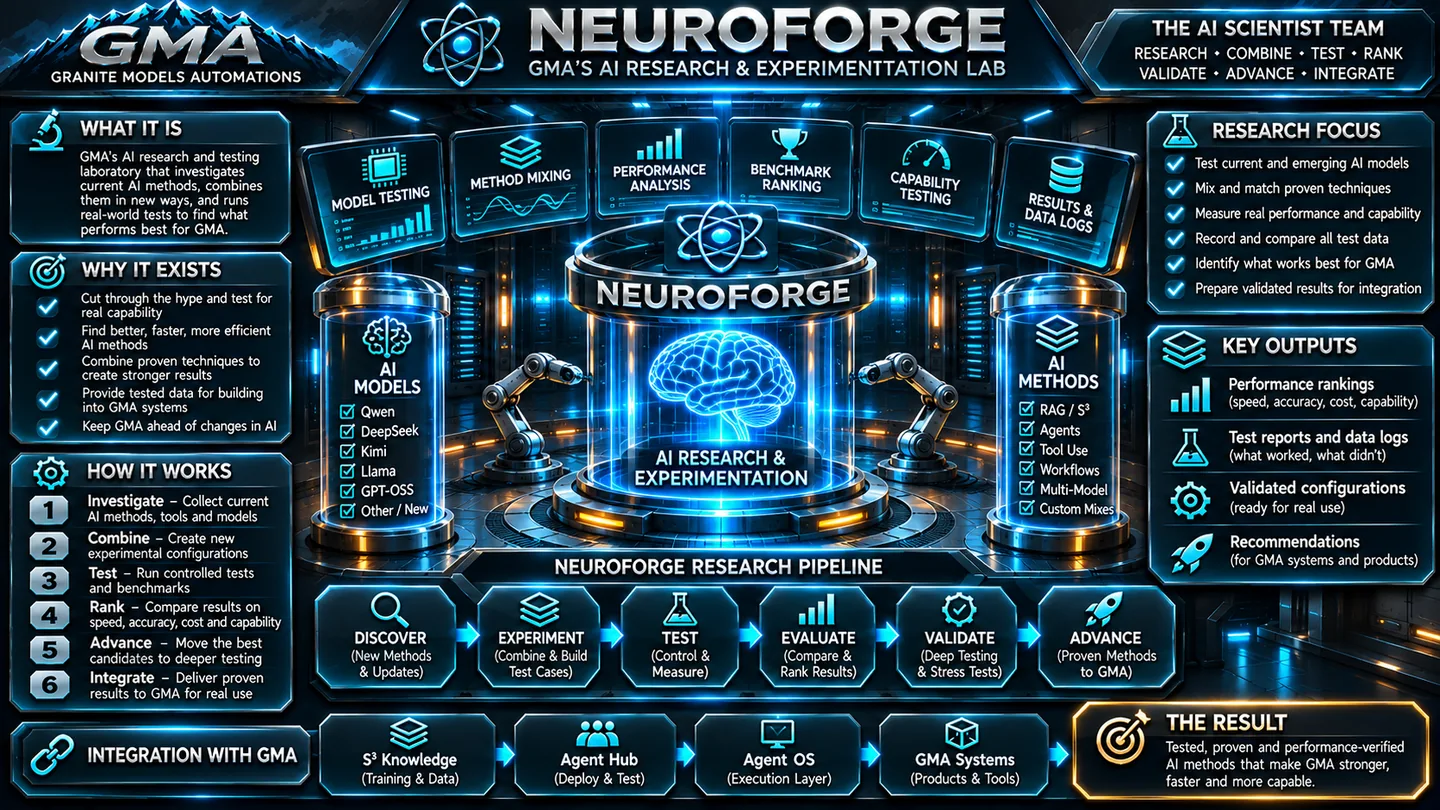
AI research advances across many separate disciplines. I want a team that studies those developments in depth rather than simply installing every new tool. My own design work on S³ reflects the kind of thinking I want to cultivate: identify a limitation, examine different approaches and consider whether a new combination can address it.
Why an AI scientist team
General research keeps GMA informed; NeuroForge is intended to turn current AI knowledge into experimental hypotheses. Its specialists would compare existing techniques, vary combinations and investigate whether those variations offer meaningful advantages. The objective is to discover and validate improvements, not to assume that combining methods automatically makes them better.
How experiments progress
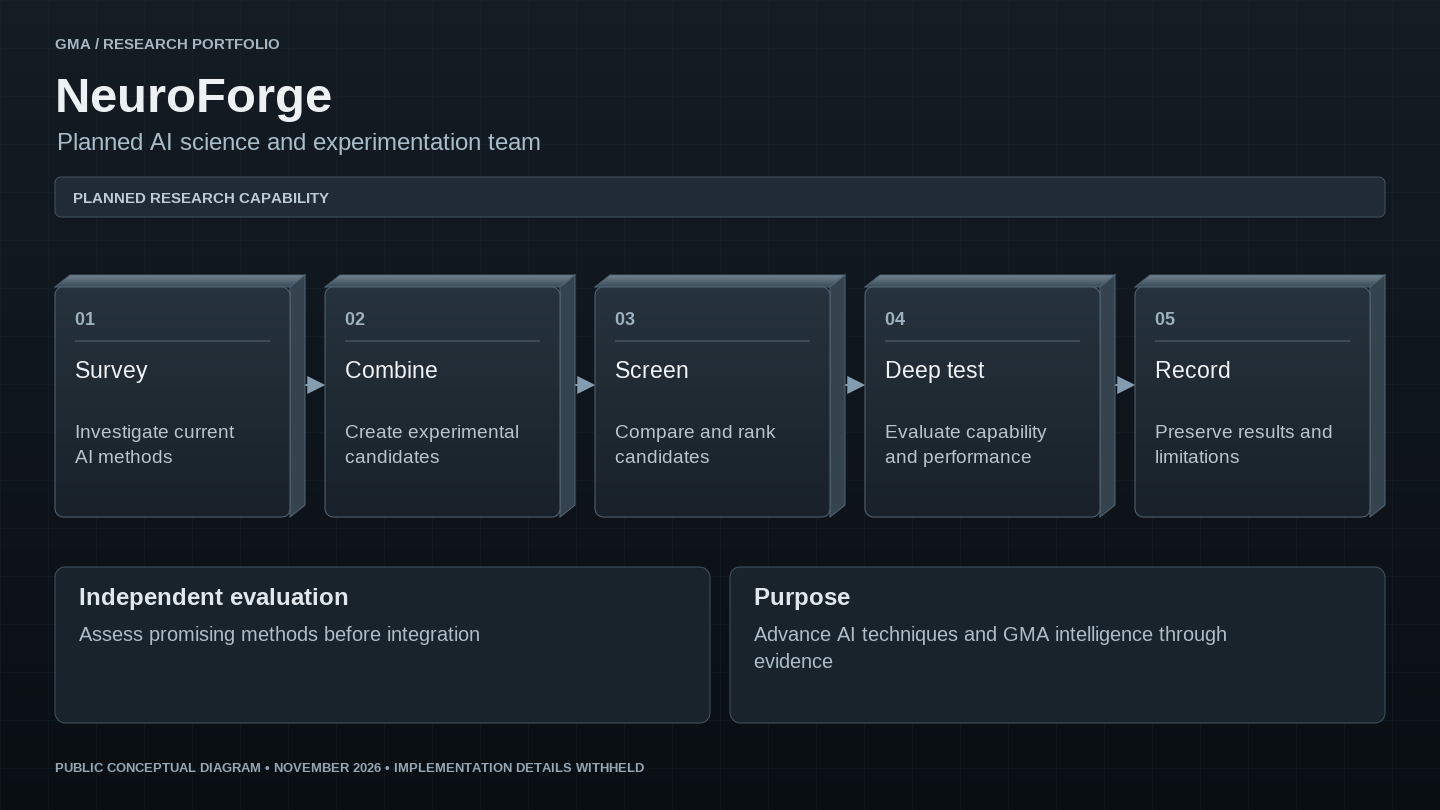
The planned research process begins with a defined question and baseline. Candidate methods and combinations are screened using comparable tasks, then ranked against predefined measures. Promising candidates advance to deeper capability, performance, reliability and resource-efficiency testing. Results, configurations and limitations are recorded, including unsuccessful experiments, so conclusions can be checked and reproduced. Computing time and experiment scope would be budgeted; private deployment details are not disclosed.
How findings advance GMA
Validated findings could inform improvements in knowledge systems, reasoning, model selection, skill composition and software engineering. Experimental results remain separate from production until independently evaluated and approved for integration. Longer-term research could include business-specialized models. NeuroForge is a planned initiative, and no experimental performance gains are claimed here.
Conceptual process / not implementation detail
From start to finish
- SurveyInvestigate current AI methods
- CombineCreate experimental candidates
- ScreenCompare and rank candidates
- Deep testEvaluate capability and performance
- RecordPreserve results and limitations
Research connections
How this connects to the wider work
Explore the related research areas and the responsibilities they address.