OFFLINE-VERIFIED EXECUTION • NOT LIVE
Design rationale & research approach
Turning an AI-generated result into accountable work
01What led to the execution design
AI-assisted development exposed a general engineering problem: a generated answer or a report of success is not proof that the requested work is correct. In a business system, that distinction matters because subsequent work may depend on the result. I wanted the architecture to retain a clear distinction between performing a task and establishing whether its outcome is acceptable.
Why separate execution from evaluation
Agent OS and the Work Ledger reflect my approach to accountable work. I chose to make the intended outcome and supporting evidence meaningful beyond the model that produces them. Independent assessment reduces reliance on self-reported success. Communication, work coordination and evaluation are separate concerns, which is why I do not intend a single general-purpose assistant to own all three.
How I research the design
The engineering question is not simply whether a model can call a tool. It is whether the overall process can produce an acceptable outcome repeatedly, under defined constraints. I examine how requirements are expressed, how results can be compared with expectations and how incomplete work can be distinguished from accepted work. My intended evaluation uses representative successful tasks as well as failure cases, measuring quality, rework and resource use. This public description intentionally excludes internal control details.
Where decision support fits
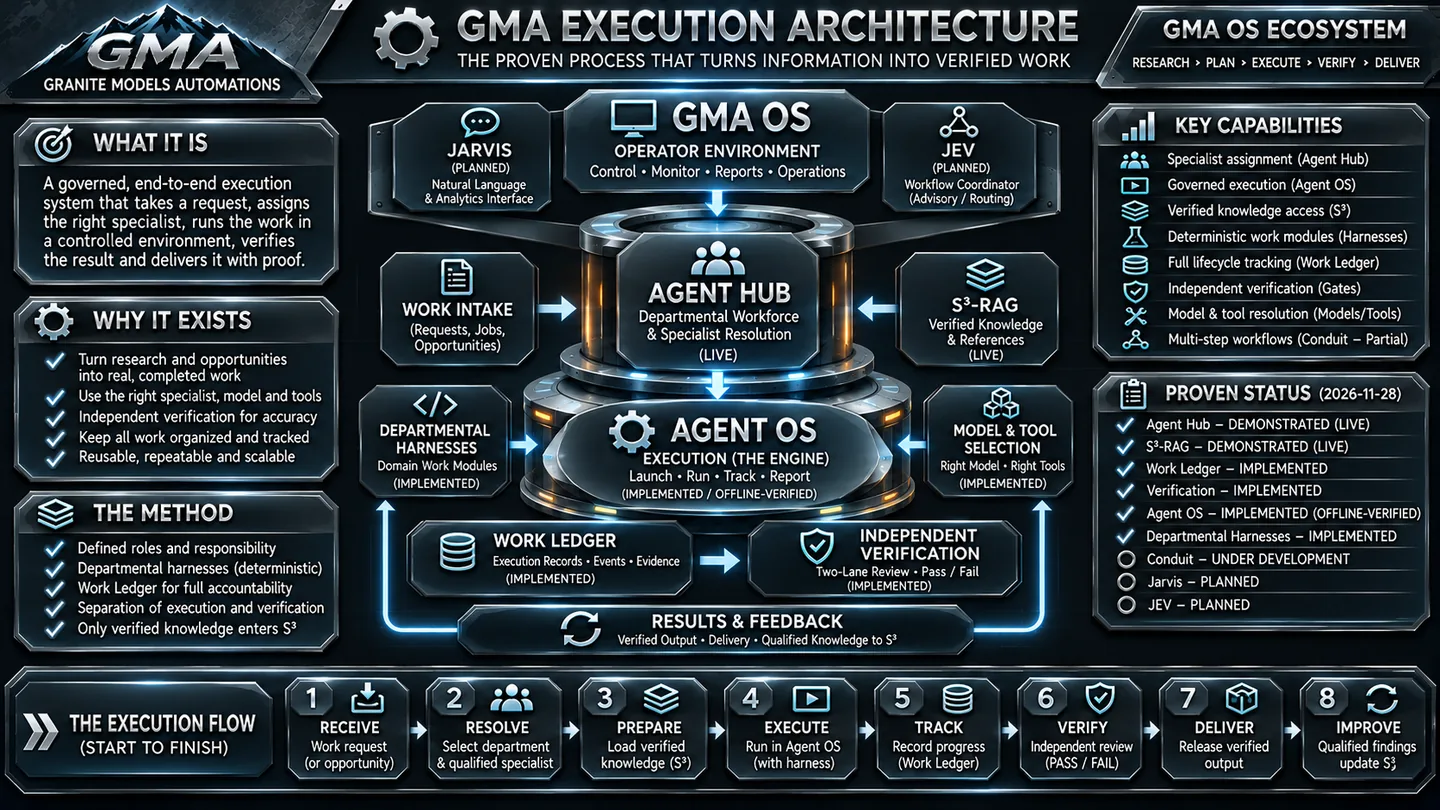
Jev is a planned advisory knowledge-and-communication coordinator intended to keep steps and hand-offs moving across a workflow. It does not execute governed work or replace independent acceptance. It is not part of the first live pilot.
The documented execution lifecycle
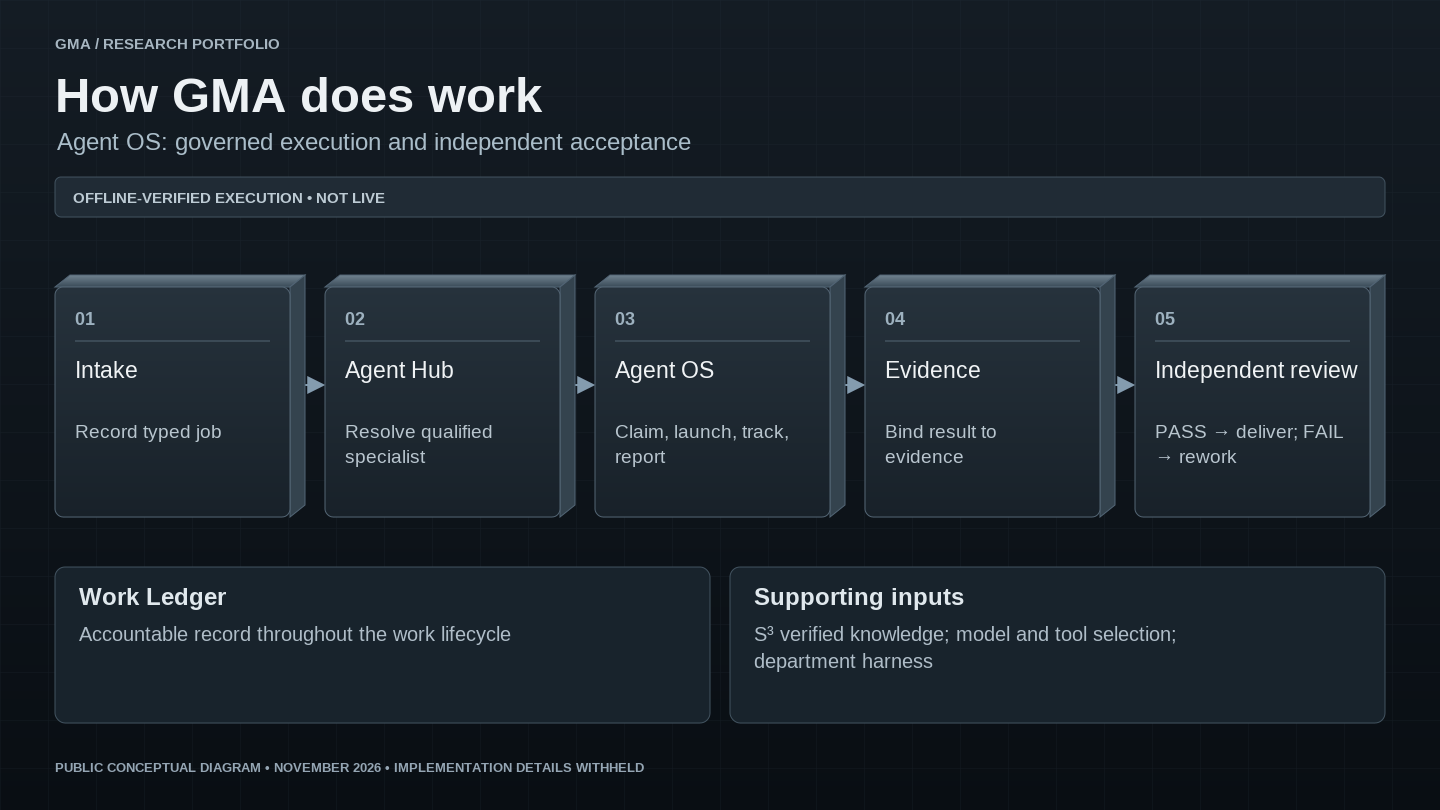
A request is recorded as a typed job in the Work Ledger. Agent Hub resolves the owning department and one qualified specialist. Agent OS claims and launches work, tracks its progress and receives a report. The departmental harness performs the defined task; the result is bound to evidence and independently checked. Only a PASS counts as accepted completion. Failed work is not accepted and can be returned for correction. The Work Ledger records the lifecycle throughout.
Current status and planned connections
Agent OS execution has been independently verified offline and is not yet deployed live. The Work Ledger, departmental harnesses and independent verification are implemented. S³ first-phase knowledge retrieval and Agent Hub have been demonstrated live. Conduit automated sequencing remains under development; Jarvis, Jev and the automated knowledge improvement loop are planned.
Conceptual process / not implementation detail
From start to finish
- IntakeRecord typed job
- Agent HubResolve qualified specialist
- Agent OSClaim, launch, track, report
- EvidenceBind result to evidence
- Independent reviewPASS → deliver; FAIL → rework
PASS → delivery. FAIL → correction and new assessment. A reported result is not completed work. Planned automated learning is separate from acceptance.
Research connections
How this connects to the wider work
Explore the related research areas and the responsibilities they address.