FIRST PHASE LIVE • LEARNING EXTENSIONS PLANNED
Design rationale & research approach
Building knowledge that remains useful beyond a single conversation
01What led to S³
When agents repeatedly search for the same procedures, tools and business information, they consume time and inference resources that could be spent doing useful work. Conventional retrieval helps find material, but finding information is not the same as establishing whether it is reliable or applicable. I wanted a persistent knowledge foundation that could serve many agents and improve over time.
Why I chose a shared learning foundation
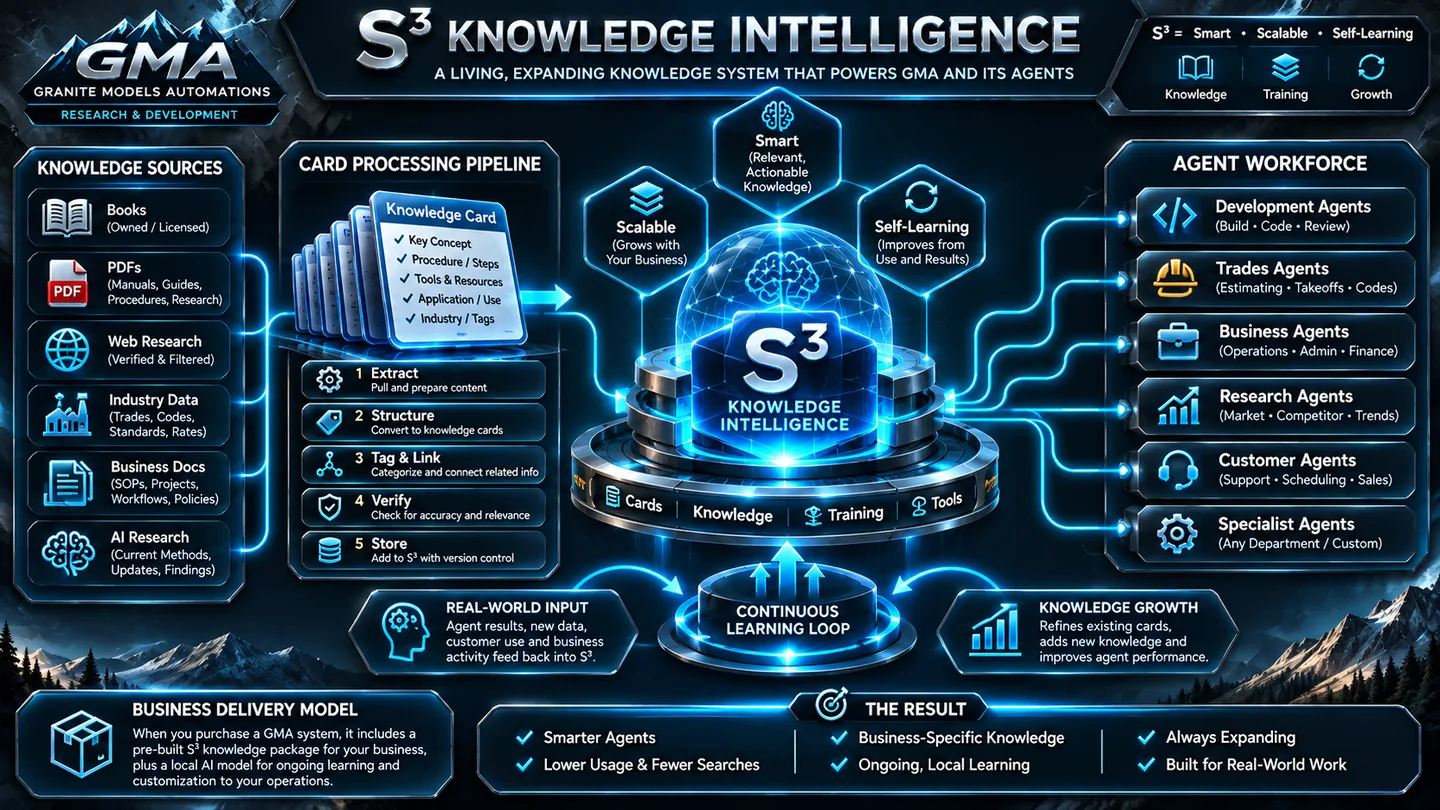
My objective is for compatible agents to connect to S³ and receive the knowledge, procedures and tool-use guidance relevant to their work. Rather than making every agent independently learn a business from scratch, the system should reuse qualified knowledge and help agents develop practical competence. Tool permissions remain with the execution system. This is knowledge-assisted learning, not a claim that connecting an agent automatically retrains its model weights.
How knowledge becomes more useful
I intend to investigate how incomplete, conflicting or aging information can be recognized and investigated through specialist research. Independently checked findings can improve the knowledge available for later tasks. I want to measure whether this reduces repeated searches, inference cost and errors while preserving accuracy. The proprietary implementation is not disclosed in this portfolio.
A learning system for each customer
When I eventually sell a packaged business system, my goal is to include the knowledge base required for its particular work and a suitable local model that can support ongoing learning from that business’s experience. A customer should start with useful domain knowledge rather than an empty system. Over time, validated procedures, new information and lessons from completed work could improve its usefulness. Customer knowledge would remain separate from other customers and GMA’s private knowledge unless explicitly authorized. This is a planned product capability, not a claim of completed deployment or automatic model retraining.
From source material to agent knowledge
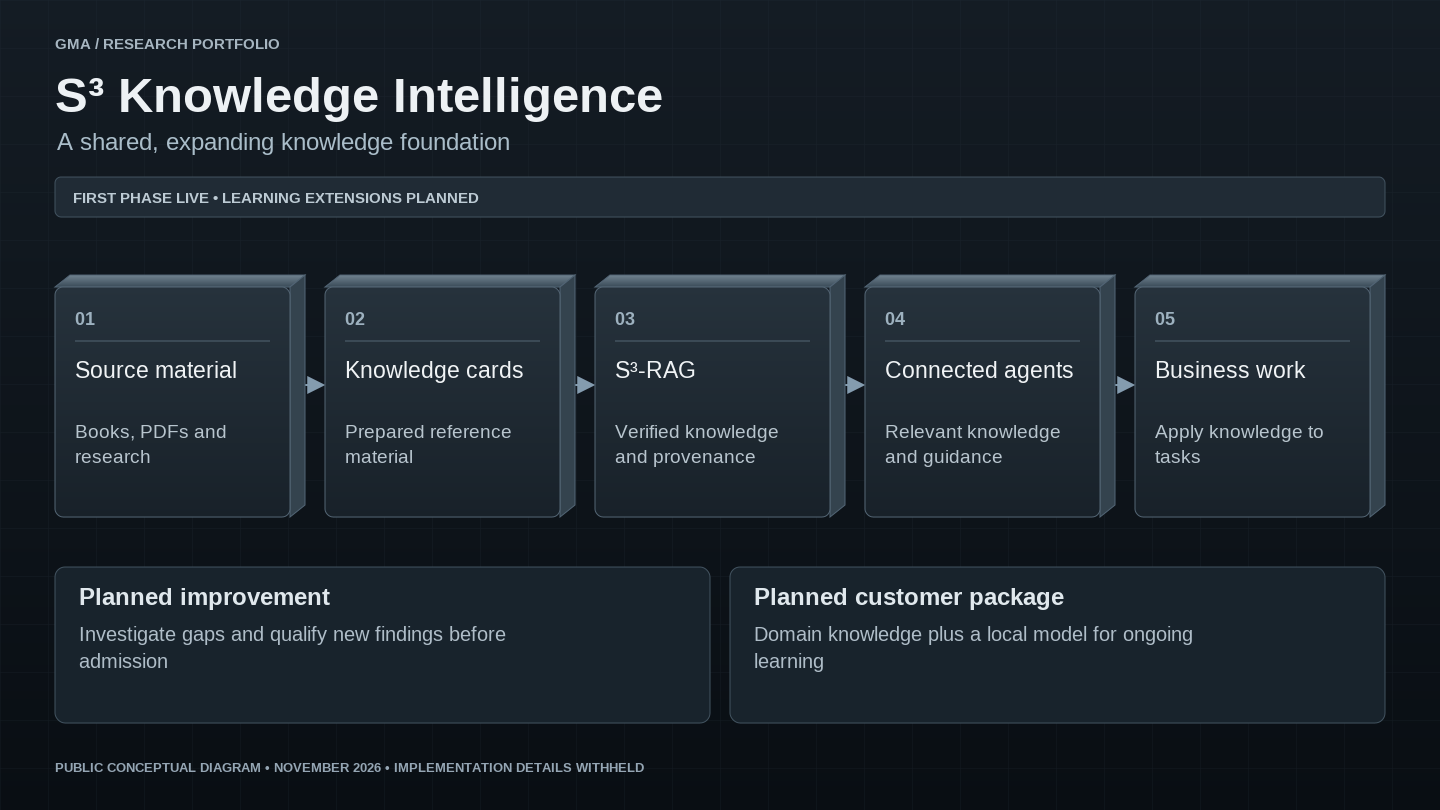
Books, PDFs and other research material are prepared as knowledge cards. S³ supplies relevant verified knowledge with provenance to compatible agents. Candidate information is kept distinct from established knowledge. The first phase has been demonstrated live. The planned automated improvement loop would investigate gaps and submit qualified findings for admission, not automatically treat every result as fact.
Conceptual process / not implementation detail
From start to finish
- Source materialBooks, PDFs and research
- Knowledge cardsPrepared reference material
- S³-RAGVerified knowledge and provenance
- Connected agentsRelevant knowledge and guidance
- Business workApply knowledge to tasks
Research connections
How this connects to the wider work
Explore the related research areas and the responsibilities they address.