EXISTING DEVELOPMENT SYSTEM • INTERNAL REPLICATION PLANNED
Design rationale & research approach
Engineering the system that builds GMA
01Why I built an in-house factory
GMA itself is a substantial software development project. Coordinating changes across many related components creates problems that a single coding session cannot reliably solve: requirements can be misunderstood, dependencies can be overlooked and an apparently successful edit may not meet the original objective. I built an internal software factory to support the construction of GMA, not as a claim that GMA already operates a commercial autonomous manufacturing platform.
Why use multiple development roles
My approach separates the work of defining architecture, implementing changes and reviewing results. AI models have different strengths, costs and limitations, so I use AI-assisted implementation and independent review rather than assume the same model is equally suited to every task. The design emphasizes repeatable development work and evidence of the intended result. My role is to define the system direction and requirements, rather than claim that I personally hand-coded every component.
How language selection fits
I intend to expand GMA toward a validated 15-language development capability. Different parts of an application may prioritize interface usability, numerical computation, data processing, integration, portability or maintenance. The right language depends on those requirements and the cost of combining technologies. More languages do not automatically make better software; a simple stack may be preferable when it meets the same needs. I intend to assess candidate stacks against equivalent requirements, including maintainability and integration effort. The complete language inventory has not yet been confirmed for this portfolio.
How the factory evolves
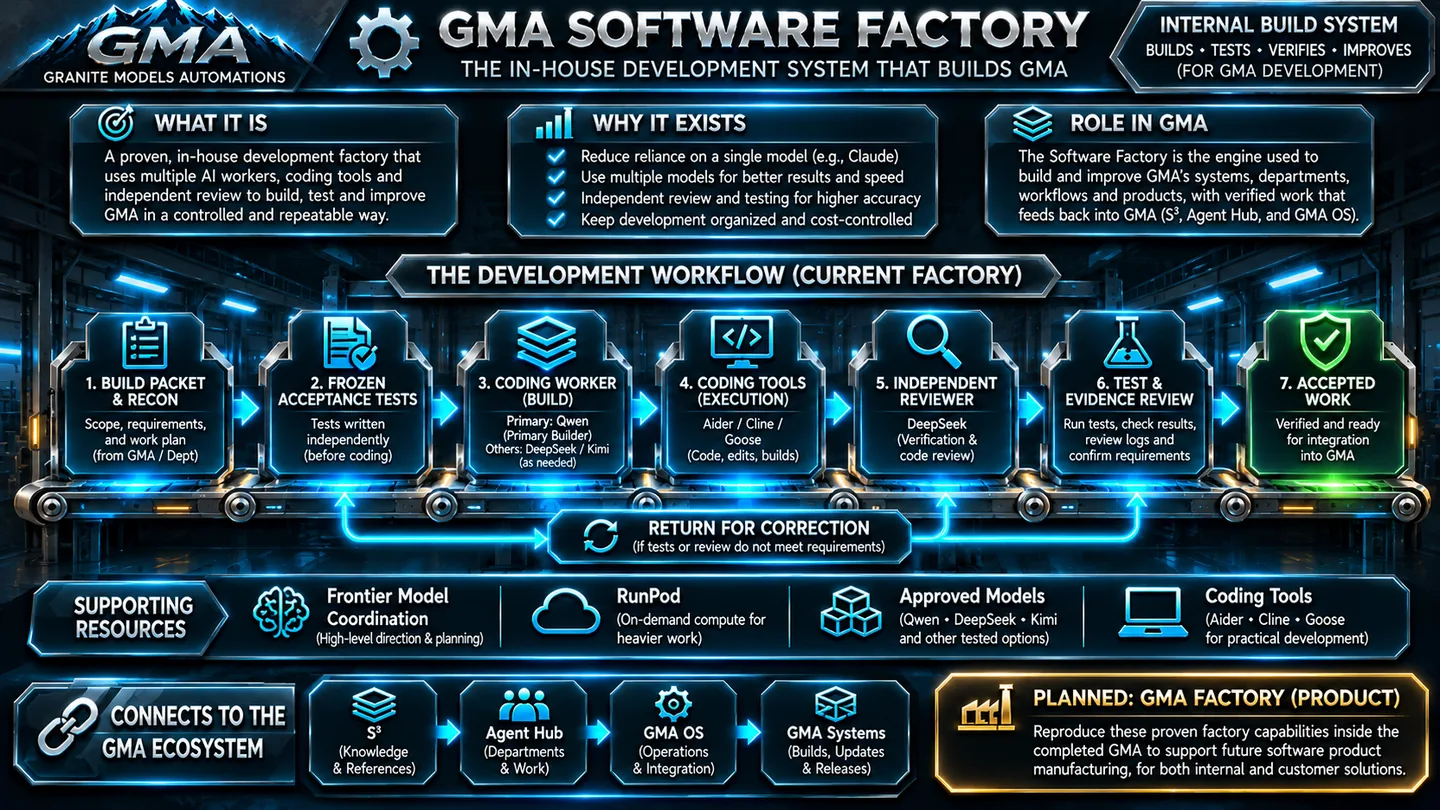
Once GMA is completed, I intend to reproduce the proven capabilities of the in-house factory within GMA. The longer-term goal is for GMA to identify business needs, design suitable software, develop and assess it, and assemble modular products for customers. That future integration depends on demonstrating the quality and reliability of the existing development approach; it is not presented as an already operational commercial system.
The current factory workflow
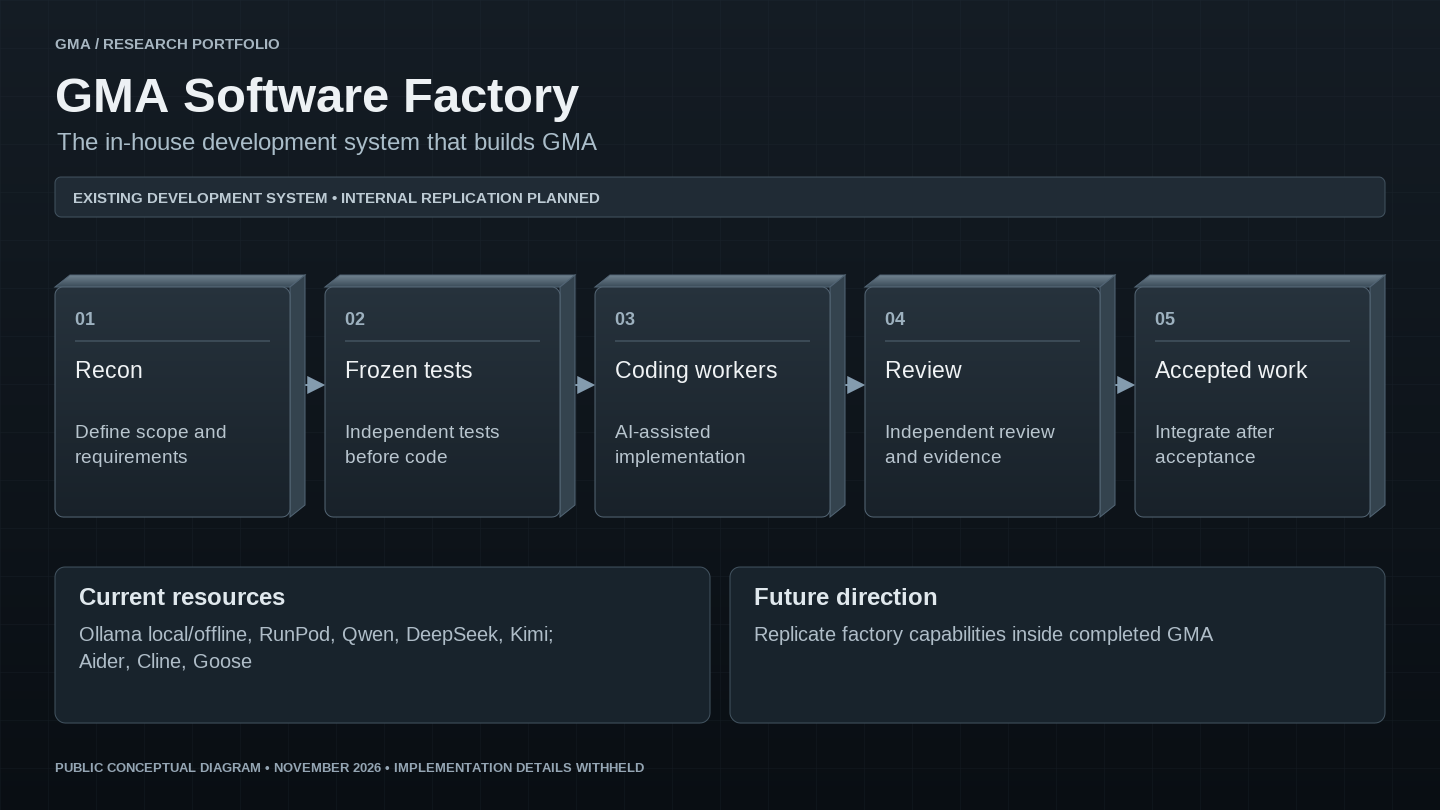
The existing internal factory uses recon and defined build packets, independently frozen tests before coding, AI coding workers and separate review. Ollama supports local/offline work; RunPod supports heavier work. Qwen, DeepSeek and Kimi are among the models used, with Aider, Cline and Goose among the development tools. These are build-time resources, not a mandatory stack for all GMA departments. Work that fails acceptance is returned for correction.
Conceptual process / not implementation detail
From start to finish
- ReconDefine scope and requirements
- Frozen testsIndependent tests before code
- Coding workersAI-assisted implementation
- ReviewIndependent review and evidence
- Accepted workIntegrate after acceptance
Research connections
How this connects to the wider work
Explore the related research areas and the responsibilities they address.