HYBRID DEVELOPMENT RESOURCES • BROADER INTEGRATION IN DEVELOPMENT
Design rationale & research approach
Matching AI resources to the actual engineering problem
01What led to hybrid computing
Different AI workloads place different demands on memory, compute capacity, response time and cost. An architecture that uses a large remote model for every operation can be unnecessarily expensive; an architecture that insists on local execution for every workload may not have sufficient capability. Building GMA independently makes the trade-off between performance and resource consumption an important engineering consideration.
Why I chose a modular resource approach
I favor separating the work requirement from the provider or model that performs it. A routine task may need a smaller resource, while complex engineering may justify a more capable model. This is not a universal rule that a smaller model is always cheaper or better: the cost of rework and the quality of the result matter. Hybrid local and cloud computing offers an approach to balancing these requirements without tying the whole system to one provider.
How I research the trade-offs
I intend to compare resources on representative tasks with equivalent inputs and acceptance criteria. Measurements should include output quality, latency, total resource cost and the need for additional attempts. The appropriate choice depends on the workload and its information-handling requirements. Detailed deployment arrangements, infrastructure configurations and internal access information are outside this public portfolio.
How it supports GMA
The specialist workforce, research capability and software factory all need computing resources, but their needs differ. A modular resource approach is intended to allow those functions to evolve without rewriting their business responsibilities whenever a model or provider changes. NeuroForge could investigate new approaches to efficiency, with independent assessment determining whether they offer a real benefit.
Current development resources
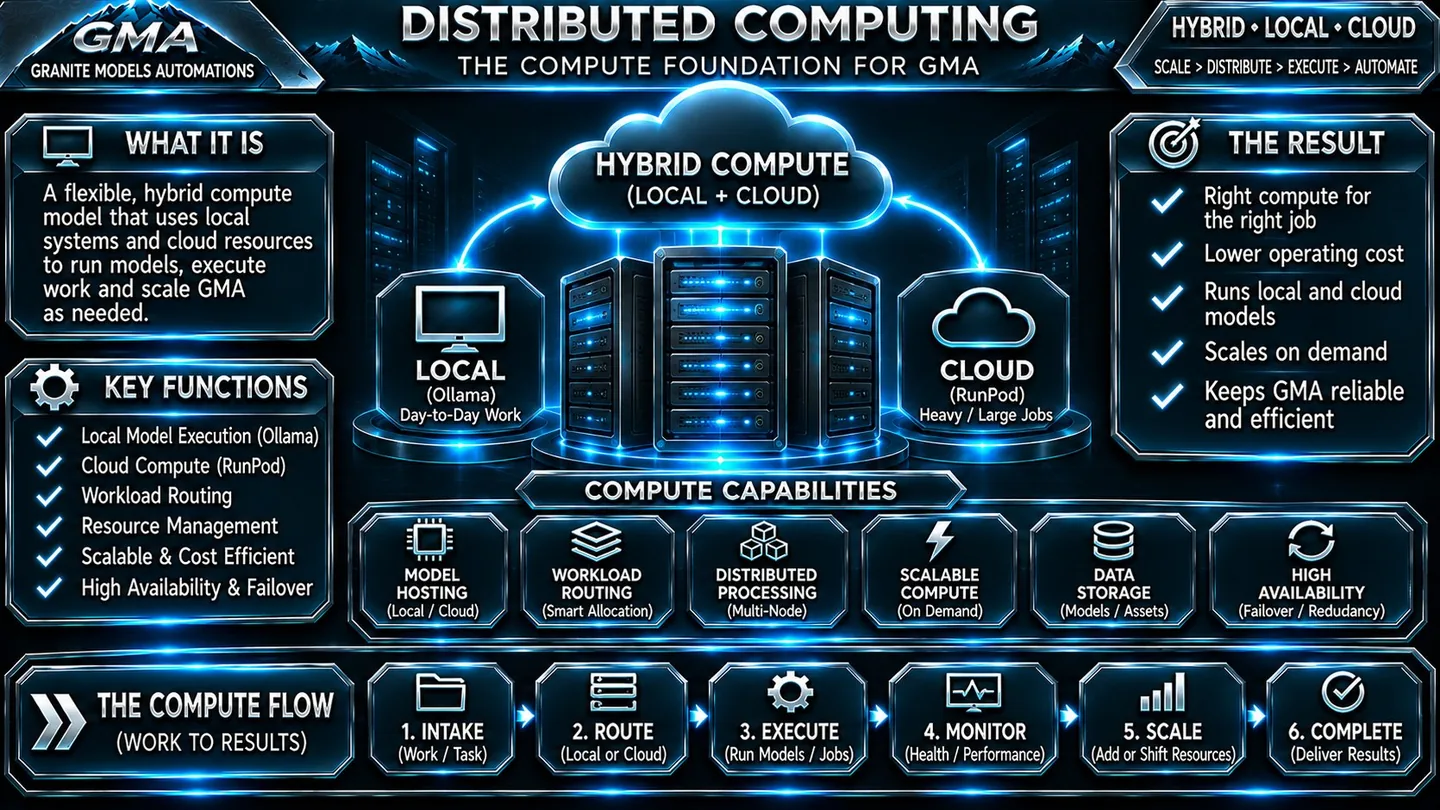
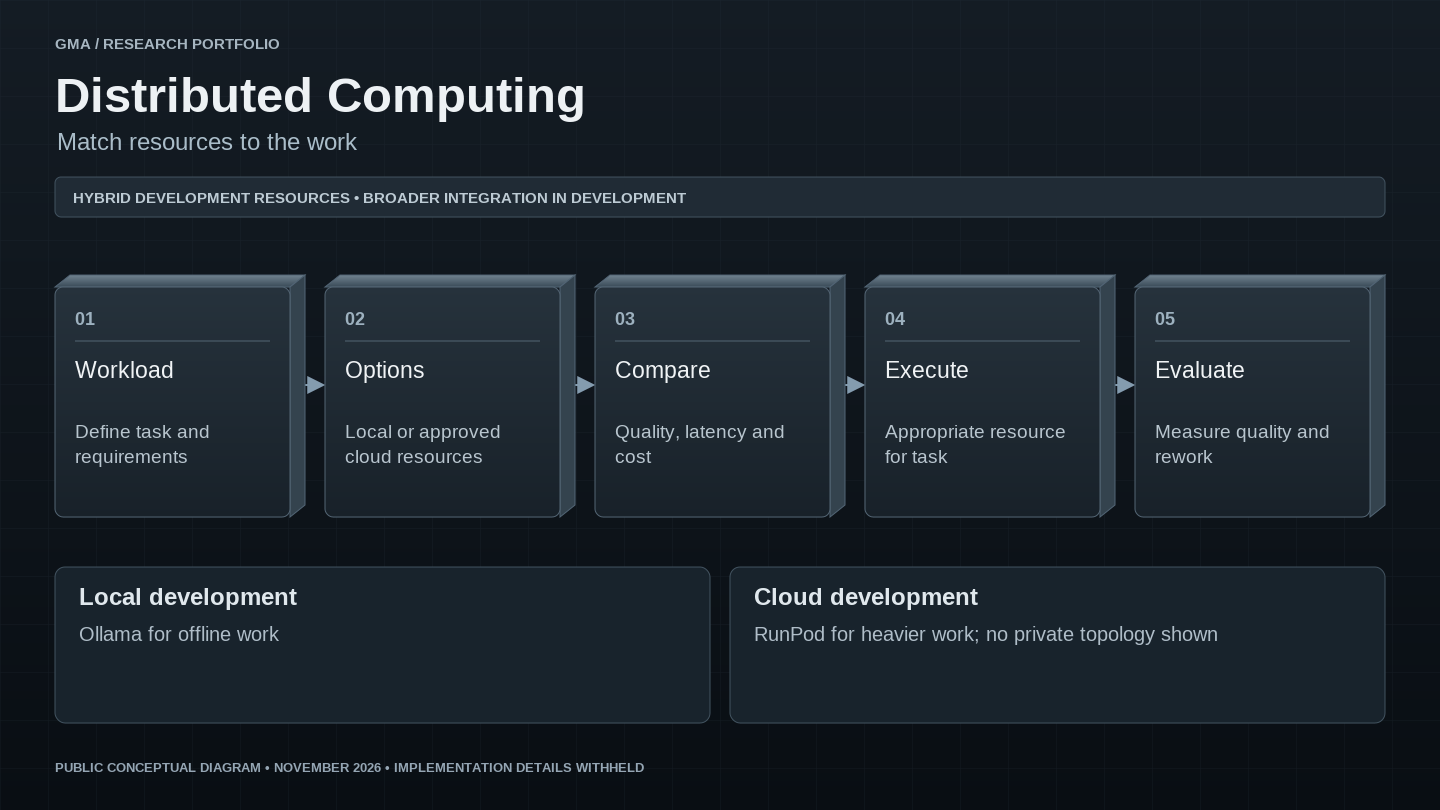
The in-house factory uses Ollama for local/offline work and RunPod for heavier computing. The broader architecture includes a model and tool resolution mechanism; its breadth varies by capability. The intended integrated allocation strategy requires further evaluation.
Conceptual process / not implementation detail
From start to finish
- WorkloadDefine task and requirements
- OptionsLocal or approved cloud resources
- CompareQuality, latency and cost
- ExecuteAppropriate resource for task
- EvaluateMeasure quality and rework
Research connections
How this connects to the wider work
Explore the related research areas and the responsibilities they address.